
Why Pinterest SEO is Your Secret Weapon for Driving High-Intent Traffic
Pinterest SEO is the strategic practice of optimizing your Pinterest profile, boards, and individual pins to achieve higher rankings in Pinterest’s search results. The goal is to connect with a unique audience of users who are actively searching for ideas, products, and inspiration.
Quick Pinterest SEO Essentials:
- Platform: Pinterest is a visual findy and search engine, not a traditional social media network.
- Audience: A massive global community of over 416 million monthly active users, many with strong purchase intent.
- Opportunity: An incredible 96% of top searches on Pinterest are unbranded, meaning users are open to finding new brands and products.
- Key Focus Areas: Strategic use of keywords in pin descriptions and titles, comprehensive board optimization, and creating high-quality vertical images (ideally with a 2:3 aspect ratio).
- Main Difference from Google SEO: Pinterest prioritizes user engagement signals (like saves and clicks) far more than traditional SEO metrics like backlinks.
- Timeline: Tangible results from a consistent Pinterest SEO strategy typically begin to appear within 3-6 months.
Here’s the fundamental concept most marketers miss about Pinterest: it’s not really a social media platform. It’s a visual search engine where millions of people go to plan their futures, find solutions to their problems, and find new ideas. When a user types “summer outfit ideas,” “small kitchen organization,” or “DIY patio furniture” into the search bar, they aren’t just passively browsing—they are in an active planning and purchasing mindset. They are gathering information to take action.
This creates a massive and unique opportunity for businesses of all sizes. Unlike Google, where search engine results pages (SERPs) are often dominated by established brands with huge backlink profiles, Pinterest levels the playing field. A well-optimized pin from a small business can appear right alongside content from major retailers in search results. This gives you direct, top-of-funnel access to users with high purchase intent at the exact moment they are looking for inspiration.
The statistics powerfully support this narrative: a staggering 90% of weekly Pinterest users say the platform helps them make purchasing decisions, and 66% report actually purchasing something after seeing a brand’s pins. This isn’t just vanity engagement for the sake of likes and comments—it’s a direct line to tangible business impact and revenue.
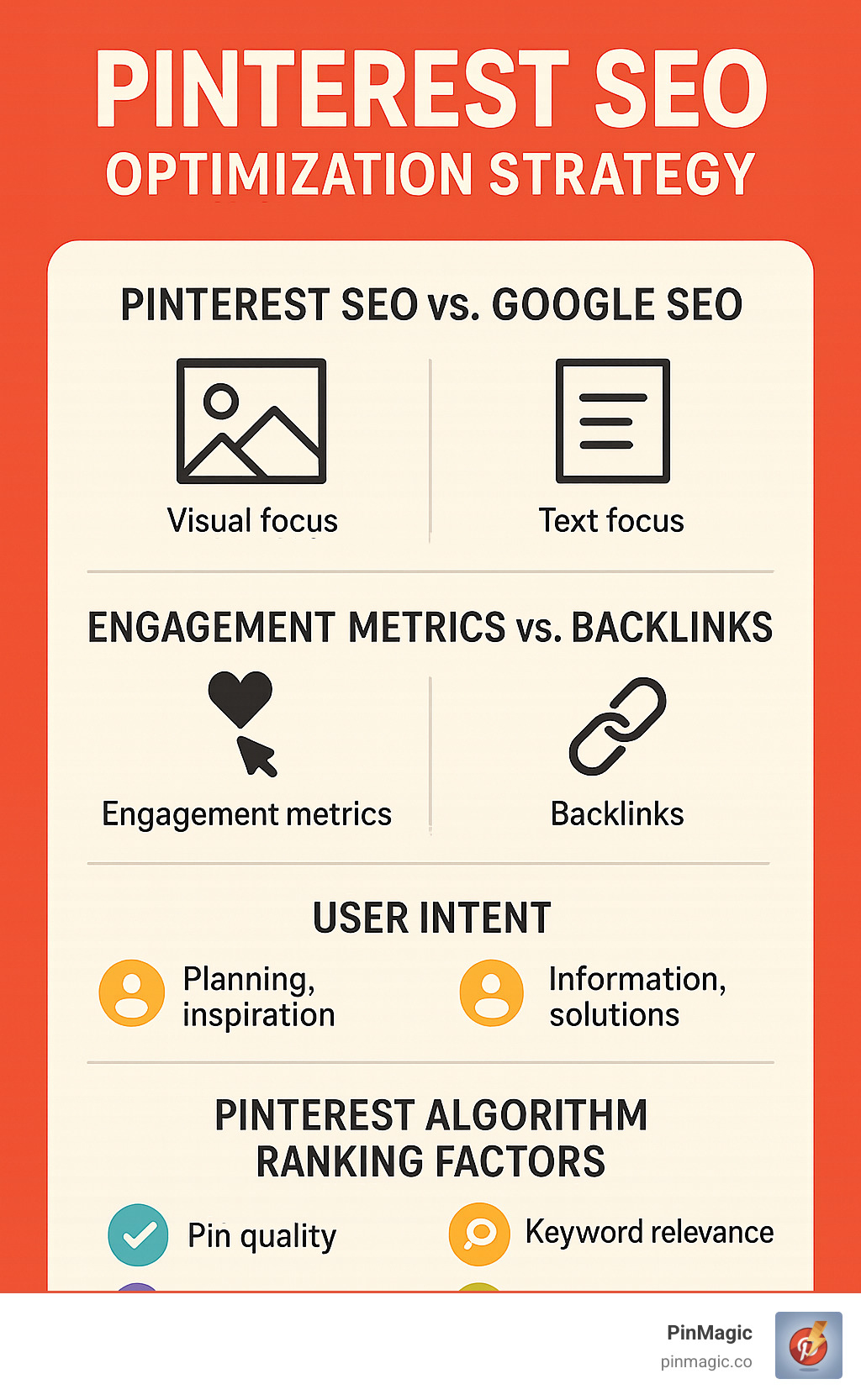
However, this is also where many brands go wrong with their Pinterest SEO. They attempt to apply the same old Google SEO tactics, which are fundamentally mismatched for a visual-first platform. Pinterest’s sophisticated algorithm cares more about user signals like saves and outbound clicks than it does about backlinks. It heavily prioritizes fresh, visually compelling content over purely technical, text-based optimization. And most importantly, it rewards consistent, long-term effort over sporadic, one-time optimization campaigns. Understanding this distinction is the first step toward building a successful strategy.
How the Pinterest Search Algorithm Works
Think of the Pinterest algorithm as a highly sophisticated digital matchmaker. Its primary function is to connect the right content (your pins) with the right people (your target audience) at the perfect moment of inspiration. Unlike Google’s algorithm, which heavily relies on text analysis and a complex web of backlinks, Pinterest SEO thrives in a visual-first ecosystem where user engagement signals and a constant stream of fresh content are the supreme currencies.
Pinterest’s algorithm analyzes multiple layers of information to deliver the most relevant search results. It carefully reads the keywords in your pin titles, descriptions, and board names. But here’s where it gets truly advanced: it also employs powerful visual recognition technology. This means the algorithm can “see” and interpret the content of your images, including identifying objects, styles, and even reading text overlays on your pin graphics. Your pin designs themselves become a critical piece of searchable content.
The real magic unfolds through what Pinterest engineers call the “Taste Graph.” This is a complex, proprietary system that maps out thousands of interests, ideas, and tastes, connecting them to individual users based on their behavior. When someone searches for “cozy bedroom ideas,” Pinterest doesn’t just perform a simple keyword match. It consults the user’s Taste Graph, considering their past saves (e.g., have they saved pins related to minimalist decor or rustic furniture?), their engagement history, and their unique taste profile to deliver a highly personalized set of results.
This is why two different users searching for the exact same term will likely see different results. Pinterest is constantly predicting what each individual will find most inspiring, relevant, and actionable based on their unique behavioral patterns. It’s a search engine that learns and adapts to personal taste.
For those interested in a technical deep-dive into how Pinterest’s search and recommendation capabilities are built, the Pinterest’s Engineering blog is an excellent resource. It offers a fascinating look under the hood of the platform.
Key Ranking Factors Explained
To truly master Pinterest SEO, you must understand the four core pillars that the algorithm uses to determine where your pins appear in search results and home feeds. These aren’t arbitrary rules; they are the system Pinterest uses to ensure users consistently find high-quality, relevant, and inspiring content.
1. Domain Quality
This factor is essentially your website’s reputation score in the eyes of Pinterest. The algorithm learns to trust domains that consistently provide high-quality content. You can significantly boost your domain quality by claiming your website, which creates an official link between your site and your Pinterest profile. Other key actions include enabling Rich Pins to pull more data from your site, consistently publishing fresh content to your blog or product pages, and ensuring that your linked landing pages are mobile-friendly and load quickly. A poor user experience after the click will negatively impact your standing.
2. Pin Quality
This pillar assesses the quality and engagement potential of each individual pin. Pinterest’s algorithm has a strong bias for fresh content, meaning new images and videos that haven’t been seen on the platform before. High-quality pins are visually appealing, use the optimal 2:3 vertical aspect ratio (e.g., 1000px by 1500px), feature clear and readable text overlays, and include compelling descriptions that encourage users to act. The algorithm closely tracks engagement signals like saves, outbound clicks, and even “close-ups” (when a user taps to view your pin larger) as direct indicators of a pin’s quality.
3. Pinner Quality
This reflects your authority, reliability, and activity level as a content creator on the platform. Pinterest rewards creators who are consistent and strategic. This means pinning regularly (whether manually or with a scheduler), creating well-organized and topically relevant boards, and focusing on providing value to your audience. Think of it as building trust with the algorithm. The more consistently you share helpful, high-quality content, the more Pinterest will trust you as a creator and prioritize showing your pins to users.
4. Topic Relevance
This is all about keywords and context. For Pinterest to show your pin to the right audience, it must first understand what your pin is about. This is achieved through the strategic placement of relevant keywords in your pin titles, descriptions, board titles, and board descriptions. Pinterest’s algorithm then cross-references this with its own visual analysis and the engagement data it collects to assign “annotations”—keywords it associates with your pin with a high degree of confidence. A strong alignment across all these text-based and visual signals tells the algorithm exactly who will find your content most relevant.
Here’s a breakdown of how Pinterest SEO’s priorities differ from traditional search engine optimization:
| Pinterest SEO | Google SEO |
|---|---|
| Visual content is the primary driver of rankings | Text content and backlinks are the foundation |
| Engagement signals (saves, clicks) are paramount | Domain authority and technical SEO are dominant |
| Fresh, new content is heavily prioritized | Established, authoritative content often ranks higher |
| User intent is focused on findy, inspiration, and planning | User intent varies widely from informational to transactional |
| Hashtags can aid in timely findy and categorization | Hashtags have minimal to no direct SEO impact |
Understanding these core differences is crucial. It clarifies why your Pinterest SEO strategy must be custom-built for this unique visual search engine, its algorithm’s priorities, and its users’ distinct behavior patterns.